Semax brain regions
The most useful word in a Semax finding may be the name of the tissue. I start by asking which tissue supplied the result.
The Semax molecule
Semax is a synthetic heptapeptide: seven amino acids joined together. Its design combines a fragment of adrenocorticotropic hormone, ACTH, with a Pro-Gly-Pro tail intended to slow enzymatic breakdown. The fragment lacks the cortisol-releasing activity of the full hormone. Semax is commonly supplied as an acetate salt.
That origin explains the design, while the experiments below explain the interest. The rat neurotrophin study is a better starting point for the brain claims than the hormone’s reputation. The word “hormone” makes me suspicious when it stands in for an effect the finished molecule has never demonstrated.
Hippocampus, cortex, brainstem and cerebellum
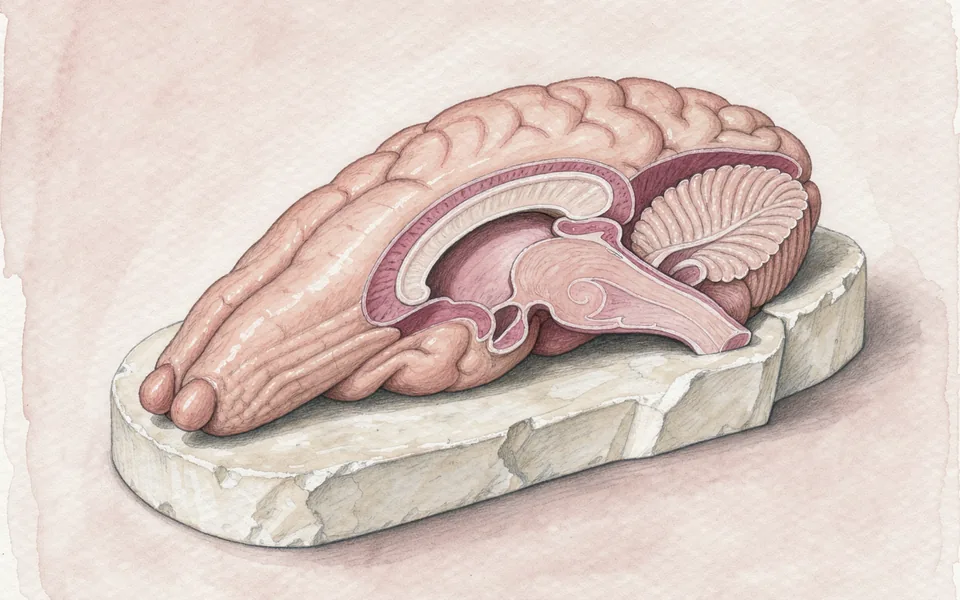
The 2007 Semax experiment used male Wistar rats and measured gene expression after a single intranasal administration. NGF and BDNF messenger RNA rose in the hippocampus. BDNF messenger RNA also rose in the brainstem and cerebellum; NGF messenger RNA fell in the frontal cortex.
Messenger RNA is the working copy a cell makes from a gene on the way to producing a protein. Those regional differences are the finding. They do not supply a score for memory, attention or overall brain health.
I initially expected a simpler story from the phrase “neurotrophin increase.” The frontal-cortex decrease persuaded me to abandon that shorthand. A regional response can be selective, and a decrease need not be treated as an embarrassment to be edited away. Its consequences would need their own tests.
BDNF protein in the basal forebrain
The 2006 binding and protein study gives a different measurement. Rat basal-forebrain BDNF protein increased at 3 hours after intranasal Semax, while the cerebellum showed no increase. Researchers also described specific, reversible, calcium-dependent binding in rat brain membranes and astrocyte cultures.
The distinction between messenger RNA and finished protein matters here. The cerebellar RNA result in the other experiment and the protein result in this one came from separate studies with different measurements. I’d ask specifically about the two measurements, their locations and their timing before forcing them into a single brain-wide claim.
Binding to tissue helps investigate a mechanism. Whether an animal remembers a task still requires a behavioral test.
Memory after cortical injury
In rats with experimentally reduced blood flow in the prefrontal cortex, intranasal Semax over six days reduced cortical infarct volume and improved retention of a conditioned passive-avoidance response. The rats remembered a learned danger better. That is a behavioral finding, obtained in injured animals.
I give this more weight for the specific question of memory after injury than a change in a protein by itself. Healthy everyday concentration remains a separate question.
The 2014 genome-wide study after a blocked brain artery in rats adds another layer: over 50% of affected genes concerned the immune system. Vascular-system genes also changed, with 24 genes at 3 hours and 12 at 24 hours. Those are gene counts. The study’s molecular measurements alone establish neither better blood flow nor stronger resistance to infection.
The spinal cord experiment
The 2025 study in female mice with spinal cord injury moves the discussion beyond the brain. Semax improved locomotor recovery and reduced an inflammatory form of cell death. The authors traced the effect through Oprm1, the mu-opioid-receptor gene, and regulation involving USP18 and FTO.
I’m glad this study exists because it broadens the mechanistic questions. Its outcome was movement after spinal injury. Using it to advertise sharper thinking would discard the very feature that makes it useful: the injured tissue and function actually tested.
The rat penetration experiment likewise answers a specific question. Tagged material appeared in the brain within 2 minutes and intact Semax broke down rapidly. Arrival and lasting benefit need different measurements.
Reported experiences; unresolved safety
People describe clearer thoughts, easier word recall, more drive and occasional mood improvement. Others describe little change, fatigue, irritability, headaches, nasal burning or disrupted sleep. These are anecdotal accounts rather than clinical evidence; expectations, other medicines and ordinary changes in daily life remain possible explanations.
I give the unwelcome accounts the same space as the enthusiastic ones. Neither set supplies a dependable frequency or a causal verdict. The research base leaves repeated use in healthy people, pregnancy, breastfeeding and many existing medical conditions inadequately studied. Research solutions also raise identity, sterility and acidity concerns.
In human serum tested outside the body, Semax slowed enzymes that degrade enkephalins, natural opioid peptides involved in pain and stress. That gives a biochemical reason to investigate interactions; the assay supplies no human safety clearance for combinations with medicines.
Russia and Ukraine register prescription Semax for stroke, brief stroke-like attacks and cognitive impairment. FDA and EMA approval remain absent. U.S. compounded prescription care requires an individual assessment by a licensed clinician, who can decline; compounded medicines are not FDA-approved. The comparison page retains the country and care distinctions in full.